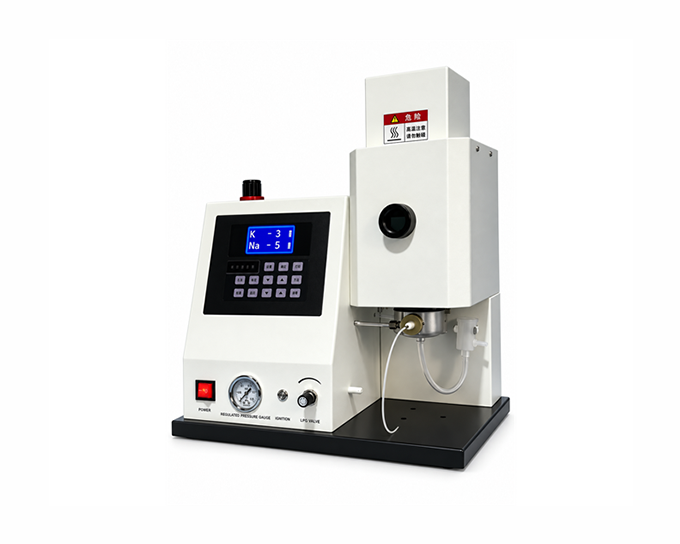
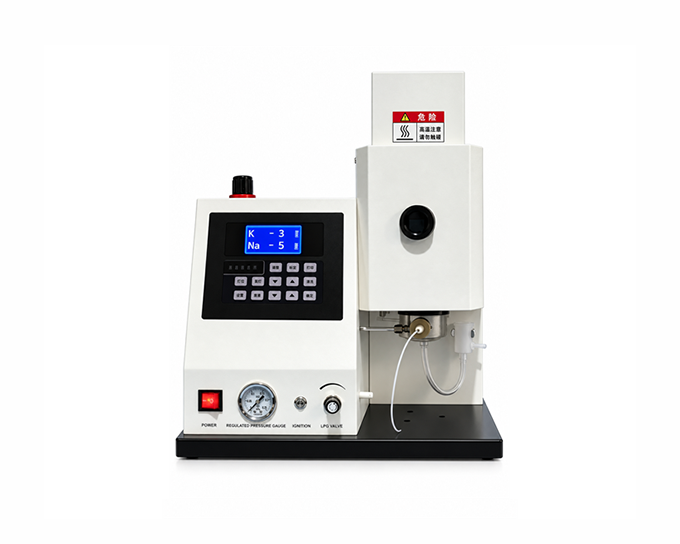
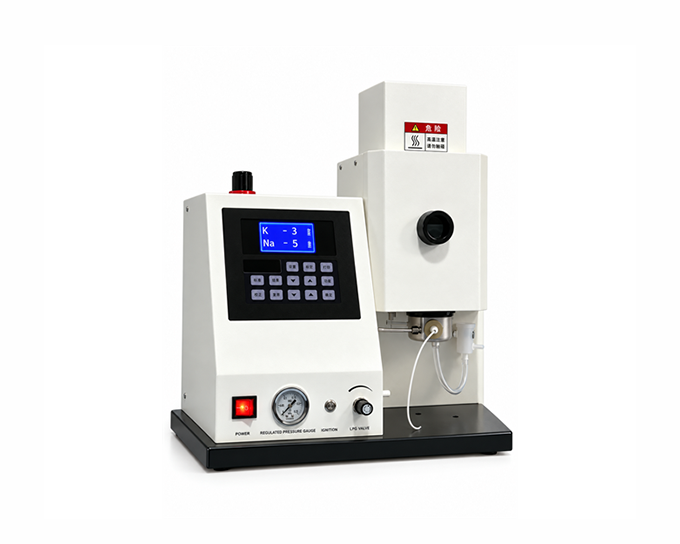
Product Overview
The Flame Photometer is an atomic emission spectroscopy instrument that uses flame emission to quantify elements such as potassium, sodium, lithium, calcium, and barium. A sample solution is nebulized into a flame, where alkali and alkaline earth metal atoms are excited and emit light at characteristic wavelengths. The emission intensity is proportional to the element concentration within the calibrated range.
With rapid analysis and straightforward operation, the instrument supports routine elemental testing in laboratories working with soils and fertilizers, cement and building materials, water, food, pharmaceuticals and clinical samples, silicates, and minerals. Available elements and functions depend on the selected configuration.
Working Principle
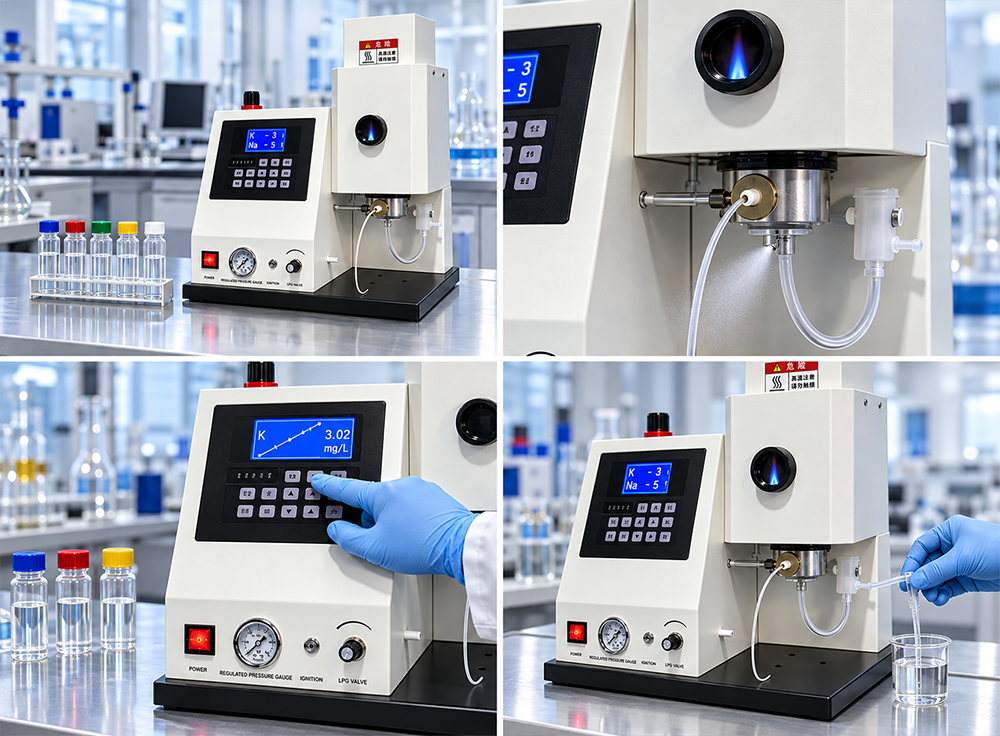
The nebulizer converts the sample solution into an aerosol and introduces it into the flame. Heat excites the atoms, which emit characteristic light as they return to the ground state. An optical filter system selects the relevant wavelengths, and a photodetector measures the light intensity. The instrument then calculates the sample concentration against a calibration curve.
This comparative quantitative method is suitable for low concentrations of alkali and alkaline earth metals. A calibration curve must be established with standards before testing.
Applications

Key Features
Technical Specifications
| Model | Basic | Soil and Fertilizer | Cement | |
| Measurement range | K | 0–100 μg/mL | 0–100 μg/mL | 0–100 μg/mL |
| Na | 0–100 μg/mL | 0–160 μg/mL | 0–160 μg/mL | |
| Detection limit | K | ≤0.004 mmol/L | ||
| Na | ≤0.008 mmol/L | |||
| Linearity error | K | ≤0.005 mmol/L | ||
| Na | ≤0.03 mmol/L | |||
| Stability | Maximum relative change in instrument reading within 15 s: ≤3% | |||
| Repeatability | ≤3% | |||
| Calibration | Two-point | |||
| Sample uptake rate | 4–6 mL/min | |||